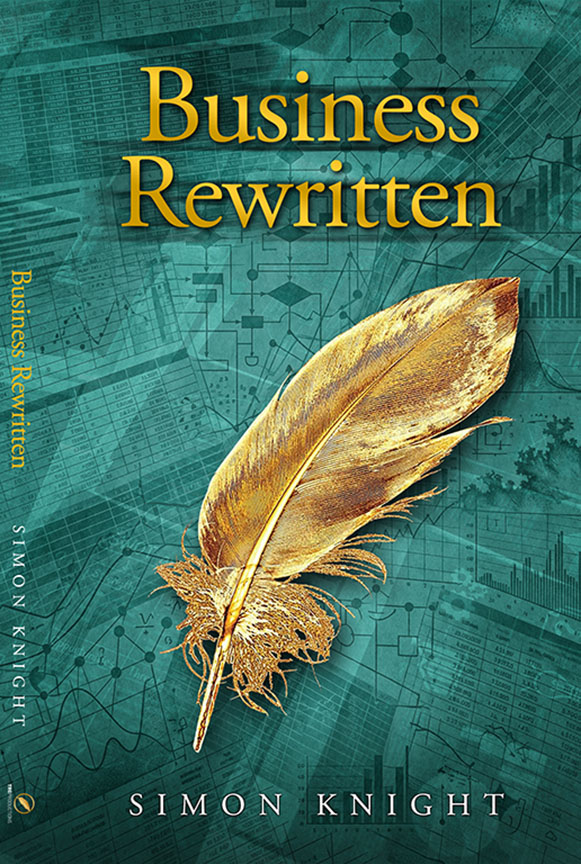
By SImon Knight
Change is hard. Business Rewritten was created for intractable problems that are complex, interconnected, and resistant to straightforward solutions. Conventional tools such as strategic planning, Six Sigma, SWOT, process reengineering, and AI-assisted analysis repeatedly miss the patterns that matter in fast-moving settings. Change falters because the things that actually drive outcomes go undetected: human dynamics, path dependencies, and hidden themes.
Business Rewritten introduces the Business Rewrite Framework, a different way of thinking about a company and of organizing what you know about it. The framework uses story as an analytical discipline rather than just a way to communicate. Every organization is a character in its own story, with customers, employees, competitors, boards, and regulators all playing a part. The framework is not a replacement for process reengineering, financial modeling, or operational improvement methods; it is the overarching framework that sits above them and points them at the right problems for the right reasons.
What Business Rewritten adds is the ability to:
- Counter the natural tendency to attack symptoms rather than causes, dissecting complex problems to discover what really makes a business tick.
- Surface unrealized opportunities, eliminate points of resistance, and clear the barriers that block change.
- Drill down into the detail while keeping the high-level perspective in view, so nothing important gets lost.
Using the power of story, the Business Rewrite Framework achieves one of the hardest things in business: effecting change successfully.
How it works
The framework begins by clarifying the objective, and from whose vantage point. Six author personas — Creator, Change Agent, Problem Solver, Opportunist, Risk Mitigator, and Investigator — each apply the framework through their own perspective. The same method can serve a founder writing the first chapter of a new business, a company facing a technology revolution, or a CEO evaluating a potential acquisition.
From there it maps the backstory: the settings the company has operated in, the events that shaped it, and the cast of characters who passed through. Then comes the work of extracting the themes, the patterns that explain why some things worked and others did not. Only after that does the framework turn forward, creating scenarios and assessing risks and opportunities as the next chapters are drafted.
Themes are where the real work happens. Delving into them reveals the root causes of problems, the barriers to progress, and the opportunities and risks concealed beneath. It is common to find repeated patterns, connections, and problems emerging from complexity; treating each one as a theme gives you a way to navigate and understand the whole story rather than a pile of disconnected facts.
The framework works because narrative is how people process complexity. Engaging with a story lets you take in more information, and gives complex ideas a shape that is memorable, relatable, and meaningful. The same property explains a common failure the framework is built to avoid: most change initiatives fail not because the destination is wrong, but because the backstory creates barriers the change plan never accounted for.
What’s inside
The first act uses the inexorable fall of Blockbuster Video as a teaching example, walking the reader through the framework against a cautionary tale most people half-remember. The second act is six case studies, each told from the perspective of a specific persona.
- Amazon. The Investigator asks whether the company that became the digital economy’s center of gravity is now too big for its own good. The case looks at whether Amazon should be broken up, and reveals that the same themes that create success can generate the vulnerabilities that threaten it.
- Dartington Hall Trust. The Opportunist leads a 14th-century English estate turned arts charity, caught between its founders’ mission and stark financial reality. The case tests whether old institutions can find new value in their backstory without selling it off in pieces.
- IBM. The Change Agent is at the helm of the most reinvented company in technology as it takes on the AI era. The case asks whether IBM’s next reinvention can succeed against a technology that is fundamentally rewriting the consulting business model.
- The U.S. Auto Industry. The Risk Mitigator contends with EV mandates, Chinese competition, and a decade of strategy whiplash, managing the downside in a story where other characters are writing the plot.
- LEGO. The Problem Solver owns a near-bankrupt toy company that became the most valuable brand in its industry. The case takes apart the turnaround and uncovers a theme of uncontrolled innovation damaging an iconic brand.
- An AI startup. The Creator is writing the first chapter in the most crowded, fastest-moving market in business history. The case is built around the questions every founder has to answer, and what is at stake when those questions get glossed over.
A search for business books on Amazon returns over one hundred thousand results. Many are written by businesspeople who succeeded because they changed a story for the better, but that success occurred within a context. You can’t easily connect the happy ever after of one story to the middle of another, and assuming that what worked in one backstory and setting will work in a different one can create a trainwreck. In the third act, Business Rewritten solves this problem by identifying the themes and character attributes themselves, rather than the surface tactics, letting you carry the right lessons from one story into another.
Business Rewritten and AI
The book was written with AI in mind. The framework structures the analysis; AI provides the speed. The combination is powerful as long as the analyst stays the author by choosing the persona, framing the call to action, demanding evidence, and deciding what the story actually is. The moment the analyst becomes a passive reader of the tool’s output, it stops working.
Epilog
Business Rewritten asks an unsettling question: what happens when the setting rewrites itself faster than the characters in most boardrooms can adapt? Where the industrial revolution took a century and the information age took forty years, the AI transition is compressing the same upheaval into something closer to a decade. It is hollowing out the middle, absorbing the routine cognitive work of analysts, junior lawyers, developers, and marketers that earlier waves of automation had pushed people into. This leaves the unresolved contradiction of an economy that eliminates the very workers it still needs as consumers.
It is a fantasy that any state can guarantee the outcome of a transition this fast. And while capitalism has lifted billions out of poverty, with no proven alternative that preserves both freedom and prosperity, the leaders who write the next chapters cannot afford a one-dimensional view of their businesses. The organizations that thrive will be those whose leaders grasp that a business story is also a political and social one, that agility beats size, that lasting success is built on relationships rather than transactions, and that characters who cannot or will not change are written out.